Offer a Rosary today for Peace with Pope Leo.
Category: Uncategorized
-
TCOLF Kenyan Feeding Program
One of our lay Catholic partners in Africa has a wonderful feeding program for children living in extreme poverty. We are looking for partners to help fund the building and renovation of a new safer, eco-friendly, kitchen on the premises. If you would like to review our proposal please see the information below and contact us or make a donation.
Thank you for your consideration.
General Donation
Your tax-deductible donation today will support our Catholic Mission Society and global outreach to the poor. Thank you for being generous to those in need. May God bless you for your kindness.
-
-
2026 Catholic Pilgrimage
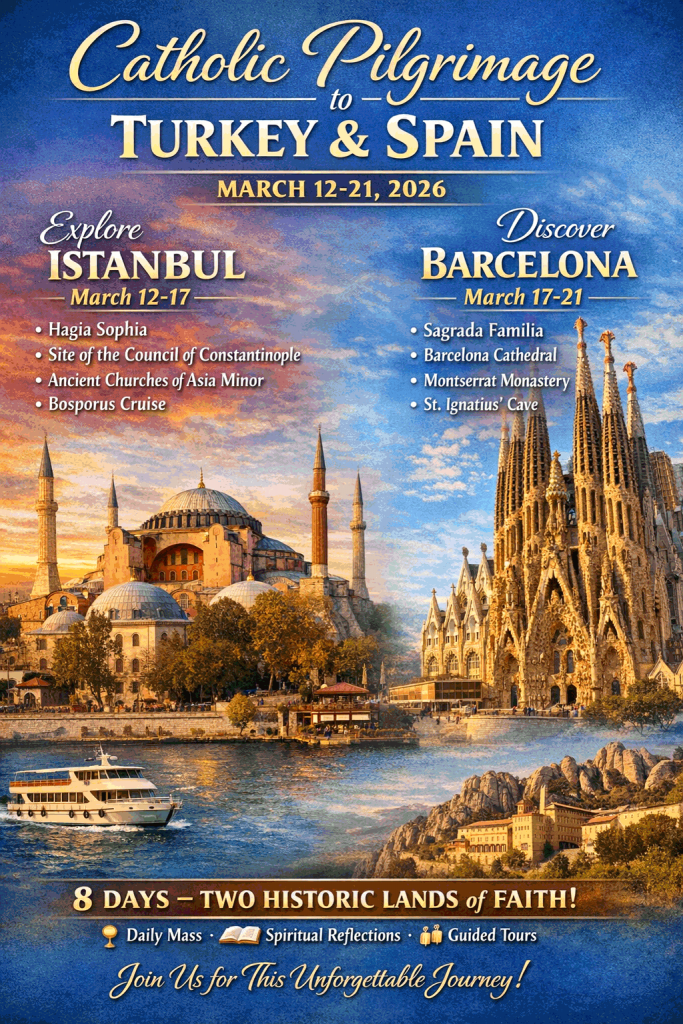
Contact us today to learn more about our 2026 Catholic pilgrimage to Turkey and Spain where we will visit historic sites in both countries. Contact us here to learn more!
-
Catholic Missions
In every generation, the Catholic Church has been missionary. The command of Christ, “Go and make disciples of all nations” (Matthew 28:19), remains the foundation of her life and purpose. The Church’s mission is not confined to a place or a time; it flows from the heart of the Gospel itself. In the middle of the twentieth century, this missionary call took on new energy. The Church was flourishing with vocations. Seminaries, convents, and novitiates were full. Education was more accessible, and many men and women found in religious life both a calling and a path of service. Pope Pius XII and, later, Pope John XXIII encouraged Catholics in countries like the United States to look beyond their borders. They urged priests, brothers, sisters, and laypeople to bring the light of Christ to nations still building their local Churches.
In those decades, missionary priests and religious from the United States responded in great numbers. Societies such as the Maryknoll Fathers and Brothers, the Missionary Sisters of Maryknoll, the Columban Fathers, and the Franciscan missionaries went to Asia, Africa, and Latin America. Some left behind their homes for the first time, bringing with them the sacraments, the Scriptures, and the gift of education. Often their missions began humbly—one priest or a small group of sisters in a rural village or growing city, teaching, building schools, opening dispensaries, or celebrating Mass under the shade of a tree. Their work was the quiet planting of faith in places that would one day grow to form strong local Churches.
A mission society, in the Catholic sense, is a community or organization dedicated to proclaiming the Gospel where the Church is still young or in need of renewal. These societies live the Church’s missionary vocation in a formal and lasting way. Some, like Maryknoll, were founded in the United States to send priests and religious abroad. Others, such as the Pontifical Mission Societies, help coordinate global missionary support under the guidance of the Holy See. Each one exists to bring the Good News to the poor and to strengthen the presence of the Church where it is least secure.
In the years following the Second Vatican Council, the understanding of mission began to expand. The Council taught that the Church herself is missionary by her very nature. This means that every baptized person shares in the mission of Christ, whether at home or abroad. The United States Catholic Mission Association, once focused on sending American clergy overseas, gradually began to reflect this broader vision as the number of clergy overseas fell. Its more recent work emphasizes that mission is not limited to geography. It is the work of evangelization, of bringing Christ’s love into the world, wherever the Gospel can be lived and proclaimed.
The landscape of mission has changed. The number of American priests and sisters serving abroad has become much smaller than it once was. Even during the height of missionary activity, only a small portion of clergy left the country for service overseas. Yet their impact was far-reaching. The seeds they planted decades ago have taken root and flourished. In Africa, Asia, and Latin America, seminaries and convents are now filled. The local Churches that were once mission territories have become strong and vibrant. Today, many of the priests who serve in American parishes come from those same countries once visited by missionaries from the United States. The mission has, in a sense, come full circle.
These international priests and sisters who now serve in the United States embody the same missionary spirit that sent their predecessors abroad. They bring new vitality to parishes, schools, and communities. Their presence reminds us that the Church is truly universal—one faith, one body, united across nations and cultures. The Gospel moves where it is needed most, and today that includes the heartland of America, where vocations are fewer and the need for pastoral care is great.
This exchange of faith and service is part of the Church’s living mission. The same Spirit that inspired missionaries of the past continues to call Catholics to support the mission of the Church in every form. Some are called to go; others are called to give. The mission is to share the light of Christ with those who need it most.
That is why CatholicMasses.org exists so we may use our resources to support the Church’s mission around the world. Across the globe, Catholic organizations serve the poor, educate children, care for the sick, and build communities of faith. Their work is a continuation of the same missionary impulse that once sent priests and sisters from the United States to distant lands. By helping them, we help Christ reach those in need. The Church’s mission belongs to all of us. Through prayer, generosity, and solidarity, every believer can share in the great work of evangelization. The harvest is still plentiful, and the Lord continues to call workers into His vineyard.
Join us as we support deserving Catholic organizations around the world..
General Donation
Your tax-deductible donation today will support our Catholic Mission Society and global outreach to the poor. Thank you for being generous to those in need. May God bless you for your kindness.
-
Guardian Angels
Belief in Guardian Angels
The Church teaches that every human being has a guardian angel. From the moment of birth, God assigns to each person a heavenly companion who watches over the soul, guides the heart, and offers protection from evil. This belief is not a sentimental idea but a truth deeply rooted in Scripture and affirmed throughout the Church’s tradition.
The psalmist writes, “For he will command his angels concerning you, to guard you in all your ways” (Psalm 91:11). These words reveal the tender care of God, who does not leave His children alone in the world. Angels serve as His messengers and helpers, carrying out His will with love and obedience.
The Gospel of Matthew records Jesus’ words about these spiritual protectors. Speaking of the little ones who believe in Him, He says, “Their angels in heaven always look upon the face of my heavenly Father” (Matthew 18:10). In this verse, Christ confirms that each soul has an angel who intercedes before God and watches over us.
The Church Fathers reflected deeply on this mystery. Saint Basil the Great wrote, “Beside each believer stands an angel as protector and shepherd leading him to life.” Saint Jerome also spoke of guardian angels as companions appointed by God to guard both the righteous and the struggling. Through them, God’s providence becomes personal and constant.
The idea of guardian angels appears even earlier in salvation history. In the Old Testament, angels are present as messengers and guides. One appeared to Hagar in the wilderness (Genesis 16), another led the people of Israel through the desert (Exodus 23:20), and still another strengthened the prophet Elijah when he was weary (1 Kings 19:5–7). These stories show that God has always sent His messengers to care for His people.
Through the centuries, the Church developed a deeper understanding of this divine assistance. The Feast of the Guardian Angels is celebrated on October 2, following the feast of the Archangels Michael, Gabriel, and Raphael on September 29. The liturgy for the day expresses gratitude to God for His invisible help and invites the faithful to trust in the quiet companionship of their guardian angel.
The Catechism of the Catholic Church teaches, “From its beginning until death, human life is surrounded by their watchful care and intercession. Beside each believer stands an angel as protector and shepherd leading him to life” (CCC 336). These words remind us that the presence of angels is not limited to children. They accompany every person through the joys and trials of life, offering silent encouragement to choose what is good and holy.
In art and devotion, guardian angels are often shown leading children across bridges or protecting families in danger. These images speak of a truth the Church has always known: God’s providence reaches us through both visible and invisible means. An angel’s work may be hidden, but its purpose is always to draw the soul toward God.
Prayer to one’s guardian angel is a simple and beautiful habit. Many Catholics learn this prayer as children and continue it throughout their lives:
Angel of God, my guardian dear,
to whom God’s love commits me here,
ever this day be at my side,
to light and guard, to rule and guide. Amen.This short prayer expresses trust in God’s care. It also reminds us that we are never alone. Even in times of fear, confusion, or sin, our guardian angel remains near, praying for us and urging us toward repentance and peace.
The saints often spoke of their angels as companions in daily life. Saint Padre Pio encouraged the faithful to speak to their guardian angels and to send them with prayers to others in need. Saint Francis de Sales reminded his readers to greet their angel every morning and to thank God for such a loyal friend. These teachings invite us to live with a deeper awareness of God’s nearness.
The presence of guardian angels reveals the tenderness of divine love. God does not send us into the world without help. He places beside us a faithful companion, unseen but real, whose mission is to guide us toward heaven.
Each time we pray to our guardian angel, we echo the words of Psalm 91 and the faith of generations before us. Angels remain signs of God’s mercy and a reminder that His care surrounds us always. Their silent watch continues day and night until the moment they lead the soul into the fullness of God’s light.
The Feast of the Guardian Angels is on October 2nd
-
Today’s Saint of the Day
Saint of the Day
Saint Faustina Kowalska — Apostle of Divine Mercy
Today’s Catholic Reflection
In Galatians, the author is surprised that the community has turned away from the true Gospel of Christ. He warns that anyone who shares a different message, even an angel, should be cursed. The author makes it clear that his message comes from Jesus Christ, not from human teachings. He shows his dedication to serving God rather than seeking approval from others.
In the Gospel of Luke, a scholar asks Jesus how to attain eternal life. Jesus points him to the law, which teaches to love God and one's neighbor. When the scholar asks who qualifies as a neighbor, Jesus shares the parable of the Good Samaritan. In this story, a Samaritan helps a man who has been attacked, while a priest and a Levite pass by without helping. Jesus ends by telling the scholar to go and show the same compassion as the Samaritan.